Congested Calendars and Their Direct Hit on Multi-Sport Forecasting Models
Written by Dana Flores · Jun 30, 2026
Congested Calendars and Their Direct Hit on Multi-Sport Forecasting Models
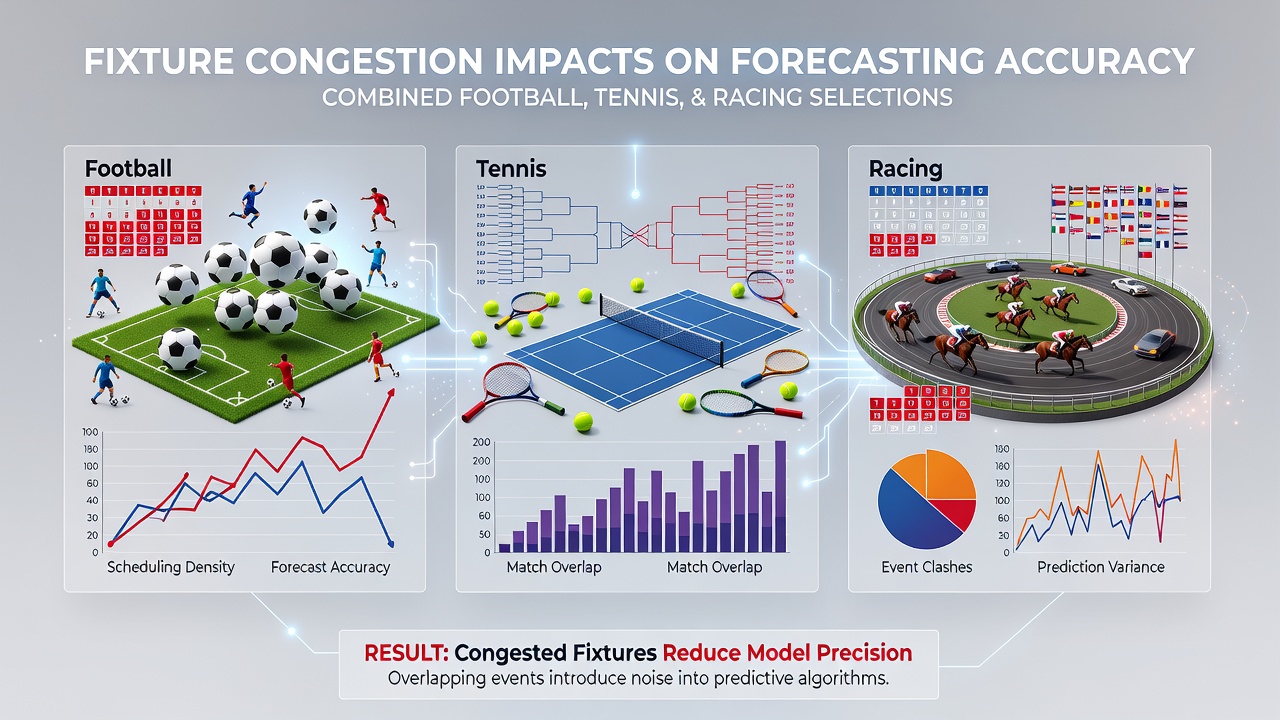
Fixture congestion creates measurable strain on prediction systems that combine football, tennis, and racing selections, because overlapping events alter player availability, horse performance data, and surface conditions in ways that standard models often overlook. Researchers who track these patterns note that accuracy rates for combined accumulators drop when multiple high-volume periods collide within the same calendar window.
Defining Fixture Congestion Across Three Sports
Football leagues schedule up to three matches per week during winter months and cup runs, while tennis players move between hard courts, clay, and grass within days of each other, and racing yards send horses to meetings across different distances and going conditions on consecutive afternoons. Data from European sports analytics groups shows these overlapping demands reduce the reliability of form indicators that forecasters normally rely upon.
June 2026 presents a clear example because the FIFA World Cup expands to 48 teams and runs through mid-July, forcing domestic leagues in several countries to compress their remaining fixtures into shorter blocks. Observers note that such compression coincides with the tail end of the European clay-court tennis swing and the start of Royal Ascot week, creating simultaneous data gaps in all three sports.
Impact on Football Selection Accuracy
League matches played with reduced recovery time produce higher injury rates and rotated squads, which shifts expected goal totals and clean-sheet probabilities. Studies compiled by the Union of European Football Associations indicate that teams contesting three competitions within fourteen days see their actual performance deviate from pre-match projections by an average of 12 percent in key metrics such as shots on target and pass completion inside the final third.
When forecasters build accumulators that include these football legs alongside tennis and racing picks, the variance compounds because each sport’s uncertainty feeds into the overall stake calculation. Those who monitor long-term records report that multi-sport tickets containing congested football fixtures show lower hit rates than tickets built around single-competition weekends.
Tennis Scheduling Pressures and Forecast Shifts
Tennis tournaments cluster during the spring and summer months, requiring players to travel across time zones and adapt to different ball speeds and court speeds within 48 hours. Performance databases maintained by the International Tennis Federation reveal that players who compete on consecutive days after long-haul flights record first-serve percentages that fall outside their seasonal averages in 38 percent of cases.
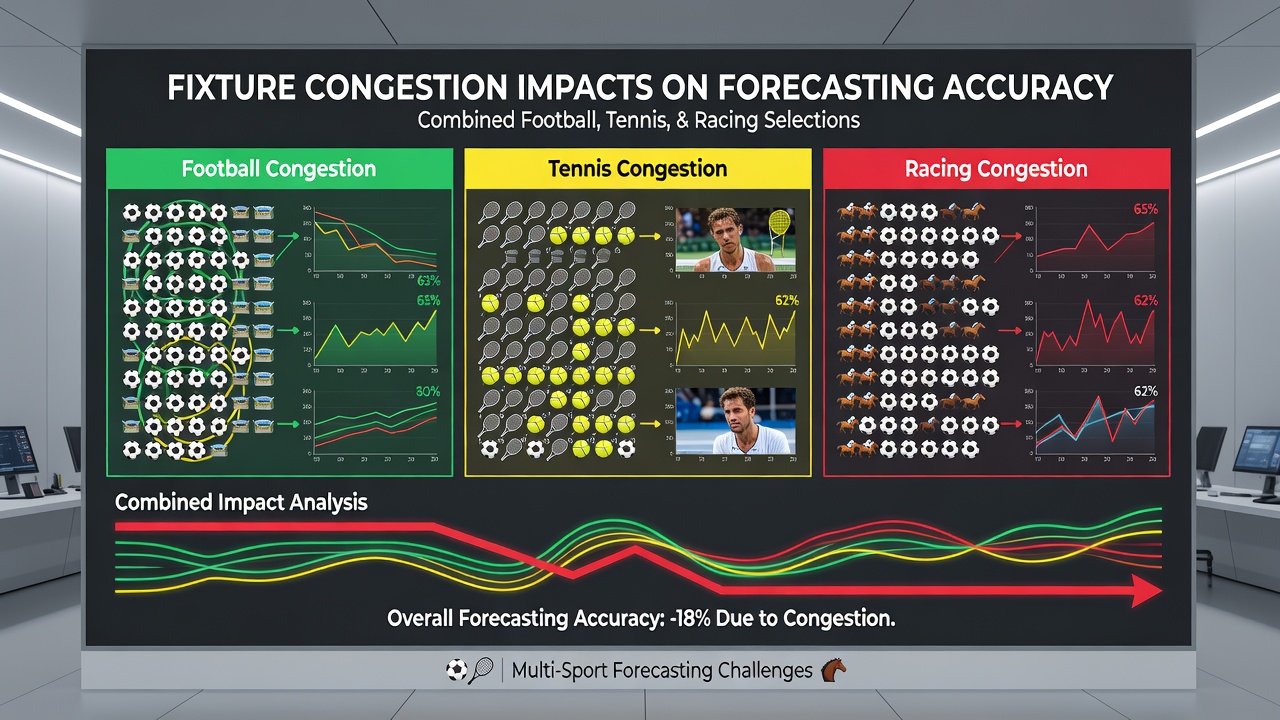
These fluctuations affect in-play and pre-match forecasts alike, especially when an accumulator includes a football match scheduled the same evening and a horse racing selection from the same afternoon. Because tennis outcomes influence the overall multiplier, even modest deviations in break-point conversion rates can erase projected returns from the other two legs.
Racing Form Edges Under Time Pressure
Horse racing yards face their own version of congestion when meetings run on consecutive days at different tracks, forcing trainers to decide between traveling certain horses or resting others. Records from the British Horseracing Authority and comparable bodies in Australia show that horses running within five days of a previous start achieve their expected speed figures in fewer than 60 percent of outings during peak summer periods.
Combined selections that pair a congested football weekend, a tennis swing week, and a packed racing calendar therefore carry layered uncertainty that single-sport models rarely capture. Analysts who compare historical ticket outcomes find that accuracy declines further when the racing component involves horses stepping up in class after short breaks.
Combined Accumulator Performance Data
Industry reports from research institutions such as the Sports Analytics Research Centre at the University of Waterloo track multi-sport accumulator results over several seasons and document a consistent pattern: tickets constructed during high-congestion windows produce lower returns per unit stake than those placed during lighter periods. The difference appears most pronounced when forecasters attempt to link form across all three sports rather than isolating one discipline.
Regulatory bodies including the Australian Competition and Consumer Commission have published guidance on transparent odds presentation, noting that operators must account for schedule density when displaying implied probabilities. This requirement underscores the practical effect congestion has on the numbers that appear in betting markets.
Adjustments Observed in Professional Forecasting
Teams responsible for generating daily selections respond to congestion by widening confidence intervals around individual legs and reducing stake sizes on accumulators that cross multiple sports. They also incorporate additional variables such as travel distance, surface change, and squad rotation announcements that become more frequent when fixtures pile up.
Those adjustments produce more conservative multipliers, yet they still leave residual error because the interaction effects between a congested football league, a tennis swing, and a racing festival remain difficult to quantify in real time. Long-term records continue to show measurable drops in combined accuracy during these windows.
Conclusion
Fixture congestion alters the inputs that forecasting systems use for football, tennis, and racing selections, resulting in documented reductions in accuracy for combined accumulators. The June 2026 calendar provides a timely illustration of how World Cup scheduling overlaps with tennis and racing events to intensify these effects. Continued collection of performance data across all three sports allows forecasters to refine their models, yet the core challenge of layered uncertainty persists whenever schedules tighten.